

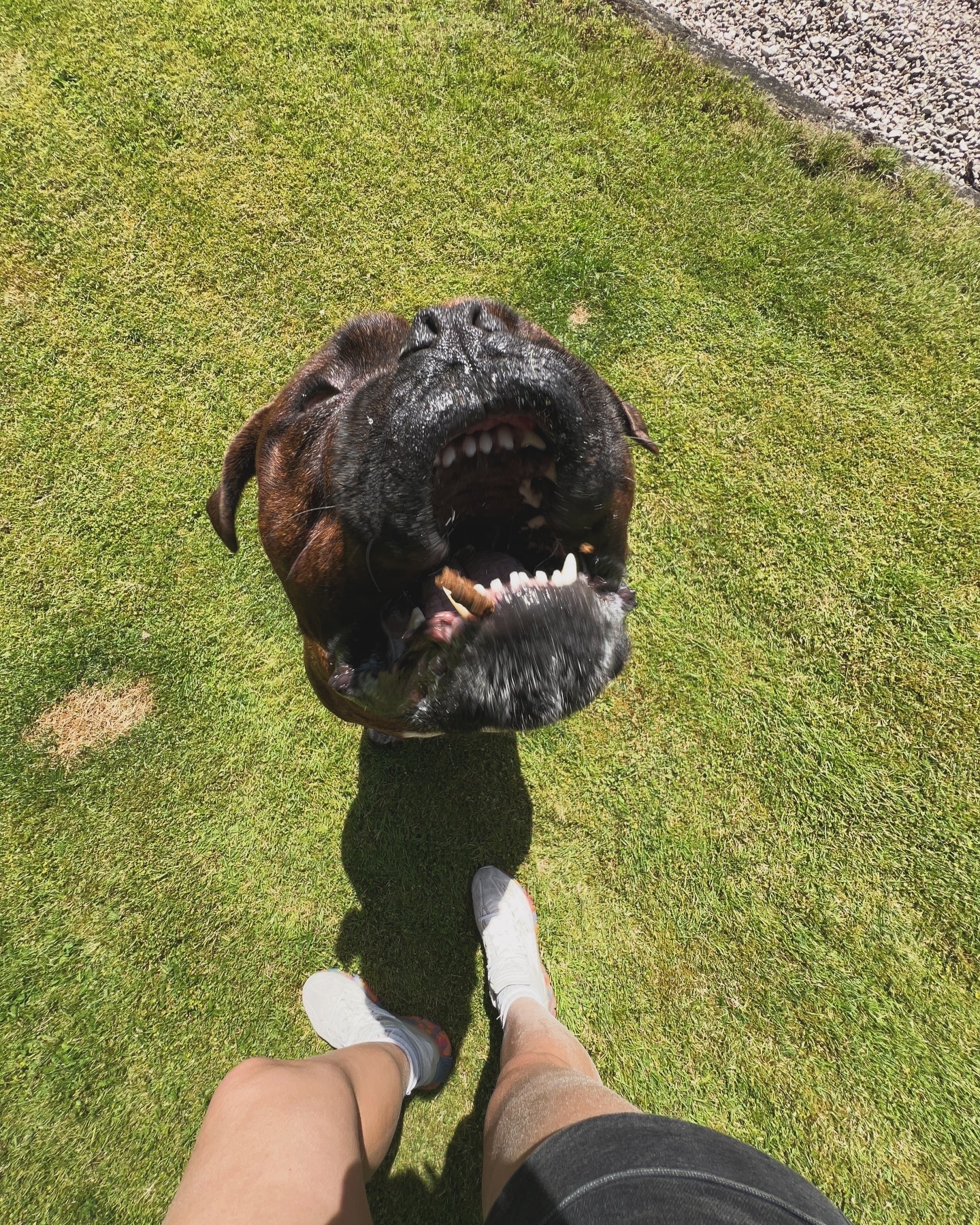
🐾 Reactive Dog Trainer in Stratford-upon-Avon: Building Tolerance, Not “Fixing” Dogs
Reactivity is one of the most misunderstood behaviours we see as a reactive dog trainer in Stratford-upon-Avon. It’s often labelled as fear, aggression, or “bad behaviour”, when in reality that’s rarely the full picture.
At DogWalk, we work with reactive dogs across Stratford-upon-Avon and Warwickshire, and more often than not, reactivity comes from big emotions, poor impulse control, and frustration — dogs who haven’t yet learned how to cope when something exciting, overwhelming, or out of reach appears.
A great example of this is Nala and Shadow, two dogs we work with regularly 🐕
When Reactivity Looks Like Excitement
When we first began working together, Nala and Shadow struggled with impulse control on walks. The moment they saw another dog, their arousal levels shot up. Pulling, barking, and lunging followed — not because they wanted to hurt anyone, but because they desperately wanted to join in.
That frustration had nowhere to go, so it spilled over into reactive behaviour.
Instead of trying to “correct” or suppress it, we went right back to basics.
Supporting Reactive Dogs in Stratford-upon-Avon Through Calm, Structured Training
👉 Management Comes First
Management isn’t a failure — it’s a foundation.We introduced haltis, not as a quick fix, but as a communication and safety tool. When dogs rehearse pulling and reacting daily, learning can’t take place.
Management helps:
- reduce rehearsed behaviours
- lower stress levels
- create space for learning
- It sets dogs up for success while new skills are being built 🐾
👉 Exercise and Decompression Matter
Physical activity is important — but so is letting dogs be dogs.
Sniffing, exploring, and calmly taking in the environment play a huge role in emotional regulation. Decompression walks lower arousal far more effectively than fast, structured walks alone.
A regulated dog learns better.
👉 Gradual Exposure Builds Tolerance
To support reactivity and build tolerance, we introduced controlled exposure in a semi-busy park.
No commands.
No pressure.
No constant cueing.
Instead, we rewarded every choice the dogs made to:
- disengage from the environment
- check back in with the handler
- remain calm
Over time, we reduced the distance to:
- dogs passing
- dogs playing
- dogs moving unpredictably
And yes — sometimes they reacted.
That reaction wasn’t aggression. It was:
“I WANT TO JOIN IN!”
That’s okay.
👉 Progress Over Perfection
Progress isn’t linear — even trainers get it wrong sometimes.
Recently, I briefly took my phone out and didn’t spot an approaching dog quickly enough. Normally, I’d create distance — something we’ve practised and reinforced many times.
This time, I was late.
Cue barking and lunging.
And you know what? It was absolutely fine.
The other owner was lovely. Smiles exchanged. “Good morning” said. We reset and carried on.
Learning isn’t about never reacting — it’s about recovering quicker and coping better 💛
👉 Impulse Control Games That Work
One of our favourite impulse control exercises is simple but powerful:
- Treats are thrown on the ground
- Dogs are rewarded from the handler for not taking them
- At the end, they hear “free” and can sniff out the treats
This builds:
- self-control
- patience
- engagement
- emotional regulation
And yes… they’re very clever 😉
✨ The Takeaway
Working with a reactive dog trainer isn’t about dominance, stubbornness, or “bad dogs”.
It’s about:
- emotions
- impulse control
- repetition
- consistency
- allowing dogs to learn at a pace they can cope with
Progress may not be perfect — but with the right setup, calm guidance, and realistic expectations, it is absolutely achievable 🐾
📍 Need Support With a Reactive Dog?
If you’re looking for a reactive dog trainer in Stratford-upon-Avon and feel stuck with your dog’s behaviour, you’re not alone.
We offer:
- 1:1 reactive dog training
- on-lead neutrality group walks
- calm, reward-based support tailored to your dog